2021 is finally here and with it, the agreed divorce between the UK and the EU. Consequently, employers and employees should consider how their immigration status may be affected from 1 January 2021.
In this briefing note, we consider some of the key steps employers can take to ensure they can retain existing EU personnel and continue to employ EU nationals.
EU Settlement Scheme
The purpose of the EU Settlement Scheme is to ensure that EU nationals residing in the UK can continue to live and work in the UK post-Brexit. EU citizens and their family members who have been resident in the UK before the 31st of December 2020, are eligible to apply for the scheme.
The immigration status of each individual depends on the number of years they lived in the UK. Those resident for more than 5 years, are granted “settled status”, while others receive “pre-settled status”, which in the course of the 5-year period, will convert into “settled status” respectively.
The government guidance has also made it clear that EU nationals can continue to use their passports and identity cards as evidence of their right to work in the UK, before 30 June 2021 (deadline to apply for the scheme).
Points-based immigration system
The UK has now implemented a points-based immigration system that treats EU and non-EU citizens equally. Anyone an employer wants to hire from outside the UK, excluding Irish citizens or EU citizens eligible for status under the EU Settlement Scheme, will need to apply in advance.
Businesses now need a sponsor licence to hire most eligible employees from outside the UK. Before applying to be a sponsor, employers should check that the people they want to hire will meet the requirements for coming to the UK for work.
Under the points-based immigration system, anyone coming to the UK for work must meet a specific set of requirements for which they will score points. Visas are then awarded to those who gain enough points.
This is part of a wider UK immigration reform that aims to achieve a more unified system, under which individuals are assessed on the basis of their skills, rather than nationality.
Skilled Worker route
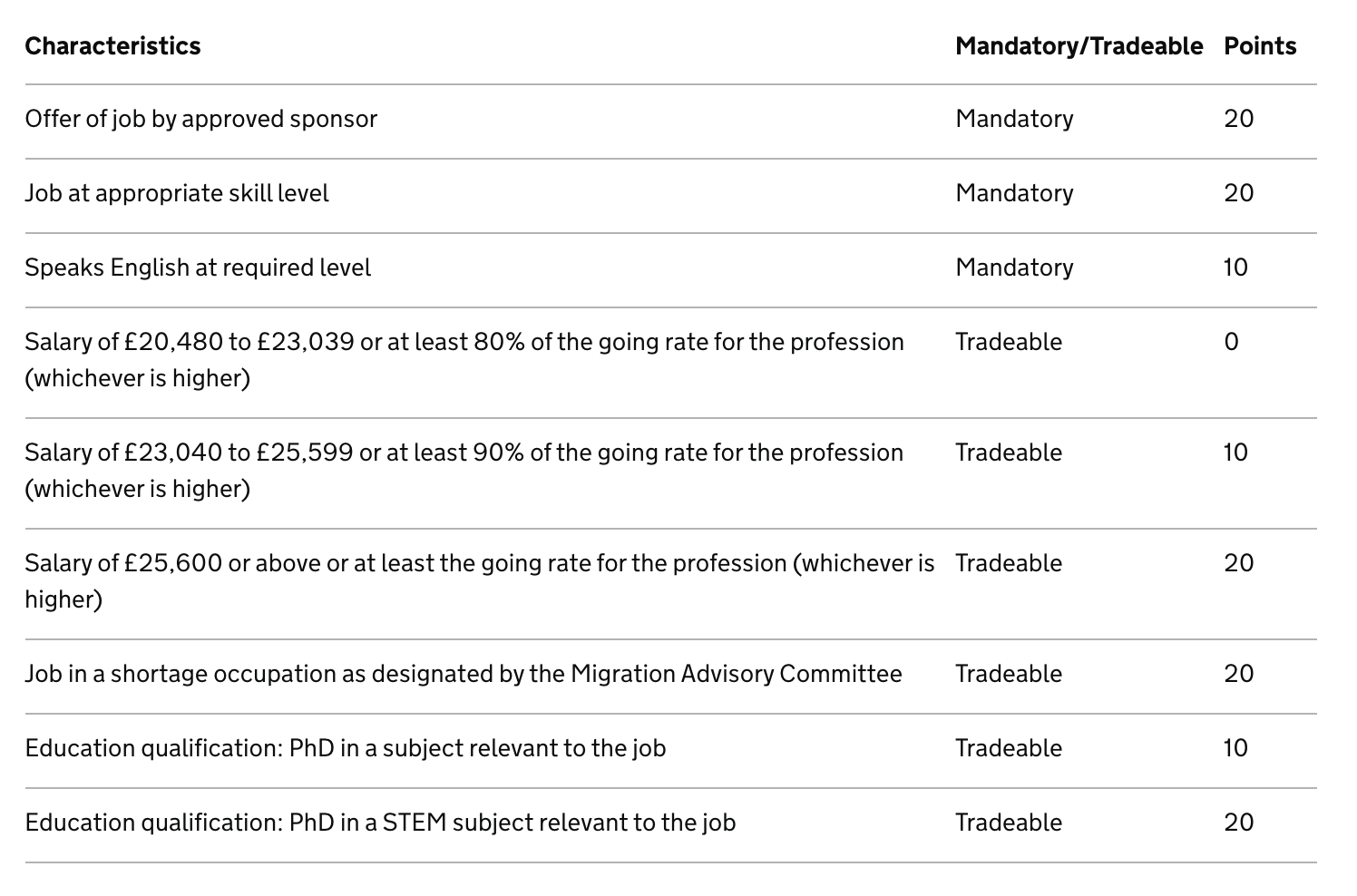
Under the Skilled Worker route, anyone employers want to hire from outside the UK will need to demonstrate that:
- they have a job offer from a Home Office licensed sponsor
- the job offer is at the required skill level – RQF 3 or above
- they speak English to the required standard
In addition to this, the job offer must meet the applicable minimum salary threshold. This is the higher of either:
- the general salary threshold of £25,600, or
- the specific salary requirement for their occupation, known as the ‘going rate’
All applicants will be able to trade characteristics, such as their qualifications, against a lower salary to get the required number of points. A total of 70 points is needed to be able to apply to work in the UK:
Alongside the Skilled Worker route, there are a number of other immigration routes to provide businesses with the flexibility they need. Some of these routes do not require to be a sponsor.
Global Talent route
The Global Talent route allows the most highly skilled applicants, who can achieve the required level of points, to enter the UK without a job offer if they are endorsed by a recognised UK body, as approved by the Home Office.
Businesses do not need to be a licensed sponsor to employ a migrant under the Global Talent route. This route is designed to attract global leaders and promising individuals in science, humanities, engineering, the arts and digital technology.
Graduate route
The Graduate visa will be available to international students who have completed a degree in the UK from summer 2021. This will enable international students to remain in the UK and work for two years after they have completed their studies.
Intra-company transfer
Multinational organisations looking to transfer foreign employees into the UK office on a temporary basis can do so under the Intra-company Transfer (ICT) route, subject to ICT sponsorship requirements being met.
To qualify for an Intra-company visa, applicants must be an existing employee of an organisation that’s been approved by the Home Office as a sponsor, have a ‘certificate of sponsorship’ from their employer and be paid at least £41,500 for an Intra-company Transfer visa or at least £23,000 for an Intra-company Graduate Trainee visa. The eligibility requirements might vary depending on the job.

Other routes
- Start-up and Innovator: the Start-up route is for those setting up an innovative business for the first time, and the Innovator route is for those with industry experience and at least £50,000 funding.
- Creative route: this route is for applicants in the creative industry who are entering the UK for short‑term contracts or engagements for up to 12 months.
- Sporting routes: sportspeople must also have a confirmed job offer and their employment sponsored by a UK employer licensed, and they must have an endorsement from the relevant governing sports body.
- Seasonal Workers Pilot: the Seasonal Workers Pilot is currently running until the end of 2021 enabling the recruitment of a limited number of temporary workers for specific roles in the horticultural sector.
- Youth Mobility Scheme: UK has arrangements in place with eight countries and territories to enable around 20,000 young people to come to the UK to work and travel each year.